
What Happens During a Dental Implant Consultation?
Before Your Dental Implant Consultation
A dental implant consultation is a planning visit, not usually the day an implant is placed. Your dentist will gather information about your health, examine your mouth, and discuss what you want to change. Knowing what happens during a dental implant consultation can make the appointment feel more straightforward and help you use the time well.
What to Bring to Your Appointment
Bring a current list of medications, including supplements and over-the-counter products. If another dentist has taken recent X-rays or scans, ask whether those records can be sent ahead or bring copies if you have them. It can also help to bring insurance details, a list of allergies, and the contact information for any physicians involved in your care.
You do not need to prepare a formal presentation. A short note describing which teeth are missing, how long they have been missing, and any discomfort or difficulty chewing is enough to start a useful conversation.
How to Prepare Your Medical and Dental History
Your dental team will ask about previous procedures, infections, gum problems, and experiences with tooth replacement. They may also ask about general health conditions, past surgeries, allergies, and habits that could affect healing. Answer as fully as you can, even if a detail seems unrelated to your teeth.
Medications and health conditions can influence bleeding, infection risk, anesthesia choices, and healing. Conditions that are well managed may not prevent implant treatment, but your dental team needs accurate information to plan responsibly. Do not stop or change a prescribed medication unless the prescribing clinician tells you to.
Discussing Your Goals and Dental Concerns
The conversation about your goals gives the consultation its direction. A missing tooth may affect meals, speech, confidence, or the way neighboring teeth feel. Some people want the most natural-looking option, while others are primarily concerned with stability or limiting the number of procedures. Your dentist will combine what matters to you with what your oral health and jaw structure can support.
Expect questions about when the tooth was lost, what caused its loss, and whether the area has changed since then. Tell your dentist which foods you avoid, whether you dislike the look of the gap, and whether you are worried about a removable appliance. The number of implants needed depends on the teeth being replaced, the condition of the surrounding teeth, available bone, and the type of restoration being considered — you can review options on our dental implants page.
Examining Your Teeth, Gums, and Jaw
The physical examination helps determine whether your mouth is ready for implant treatment and whether another issue needs attention first. Your dentist will inspect the proposed implant site as well as the surrounding teeth and gums, checking for decay, broken teeth, infection, inflammation, and areas that are difficult to clean.
An implant needs suitable bone in the right location for support. During the examination, your dentist considers the shape and width of the ridge and whether the area appears adequate for the proposed restoration. Active gum disease can affect the tissues around natural teeth and may complicate implant care, so your dentist will also look for bleeding, swelling, pockets, recession, and signs of infection. Your bite is assessed as well, since the replacement has to fit into the movement and contact pattern of the rest of your mouth.
Imaging and Treatment Planning
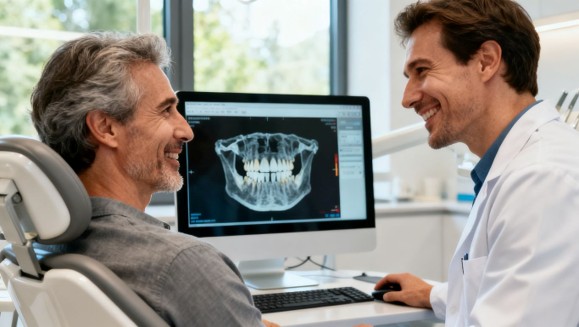
Imaging gives the dental team a view beneath the gumline and adds detail to the clinical examination. Depending on your situation, the consultation may include traditional dental X-rays or a three-dimensional scan. A dental X-ray may provide useful information about the tooth roots, surrounding bone, and nearby anatomy, while a three-dimensional scan can offer more detailed views when the site is complex or the relationship with important structures needs closer evaluation.
The upper and lower jaws contain structures such as sinuses and nerves that must be considered when an implant is planned, and imaging helps the dentist understand these relationships before recommending placement. If the available bone is too narrow, too short, or otherwise unsuitable for the proposed implant, your dentist may discuss bone grafting or another preparatory procedure.
Reviewing Your Dental Implant Options
Once the examination and imaging are understood, the dentist can explain the choices that may fit your situation, which can include an implant-supported restoration, another way to replace the tooth, or a staged approach that begins with treating an existing problem.
Your dentist may compare an implant-supported replacement, such as our All-on-4 option, with other tooth-replacement approaches such as a denture or bridge, each of which can differ in stability, maintenance, appearance, preparation, and cost.
The implant position is planned in relation to the bone, bite, gumline, and final tooth shape. Some patients need treatment before implant placement, which may include removing a damaged tooth, treating gum disease, allowing an extraction site to heal, or considering bone grafting.
Discussing Sedation and Anesthesia Options
Ask what type of local anesthesia is normally used and whether sedation may be appropriate for your procedure. The choice can depend on the planned treatment, your medical history, medications, anxiety level, and the arrangements required afterward. If sedation is discussed, ask about fasting, transportation, recovery, and restrictions for the rest of the day.
Understanding Costs, Risks, and Next Steps
The final part of the consultation is usually a practical review of money, timing, healing, and what happens next. The total cost may reflect the number of implants, the type of restoration, imaging, extractions, grafting, sedation, temporary teeth, and follow-up visits. Ask for a written treatment plan and an itemized estimate, and check our financial information page for payment options.
Dental insurance may treat the implant, restoration, extraction, imaging, and related procedures differently, so your insurer is the best source for confirming benefits, exclusions, waiting periods, and annual limits. Your dentist should also explain possible risks associated with the proposed treatment, including infection, discomfort, swelling, bleeding, and delayed healing, along with which symptoms should prompt a call to the office.
Knowing When You Are Ready to Schedule Treatment
You may be ready to schedule when you understand the recommended plan, alternatives, expected timeline, estimated cost, and aftercare. You should also know which health or dental conditions need attention before treatment begins. A thoughtful decision does not have to be rushed; once your questions are answered and the plan fits your goals, our team can help arrange your first treatment appointment.
Conclusion
A dental implant consultation brings together your goals, health history, oral examination, imaging, treatment choices, cost information, and next steps. Bring accurate records, describe what you want to improve, and ask how each recommendation affects timing and recovery. With that information in hand, you can make a more informed decision about whether implant treatment is right for you. Request a consultation with our Spokane team to get started.
Frequently Asked Questions
Is a dental implant placed during the consultation?
Usually, the consultation is used for discussion, examination, imaging, and planning rather than implant placement. Your dentist will tell you if any procedure is planned for that visit.
How long does a dental implant consultation take?
The length varies according to your needs, whether imaging is performed, and how much treatment planning is required. Ask the office when scheduling so you can allow enough time for questions.
Should I bring my medication list?
Yes. Include prescriptions, over-the-counter medicines, vitamins, supplements, and known allergies. Accurate information helps the dental team plan safely and determine whether medical coordination is needed.
Will I need a 3D scan?
Not everyone needs the same imaging. Your dentist may recommend a three-dimensional scan when more detailed information about bone and nearby structures is needed for planning. According to the American Dental Association's MouthHealthy resource on implants, dental implants are posts surgically placed in the jaw where they function as a sturdy anchor for replacement teeth, and your health is more of a factor than your age in determining candidacy.
Can gum disease prevent dental implants?
Active gum disease may need to be treated before implant placement. Improving gum health can help create a better environment for treatment and long-term maintenance.
How soon can implant treatment begin after the consultation?
The timing depends on examination findings, imaging, insurance or payment arrangements, and whether preparatory procedures are needed. Your dentist can outline the likely sequence for your situation.
What should I do if I am nervous about the appointment?
Tell the dental team before and during the visit. They can explain each step, discuss comfort measures, and review whether sedation or other support may be appropriate for any planned procedure.
About the Author
Pacific Northwest Prosthodontics is located at 826 North Mullan Road #D, Spokane Valley, WA 99206. The practice is led by prosthodontic specialists Dr. Michael Brooks and Dr. Michael Johnson, who together have completed more All-on-4 implant-supported denture cases than any other prosthodontic practice in the state of Washington, providing implant restorations, dentures, crowns, bridges, and maxillofacial prosthetics to patients throughout Eastern Washington, Northern Idaho, and Northern Oregon.
Disclaimer
The information provided in this article is for educational purposes only and does not constitute professional dental advice, diagnosis, or treatment recommendations. What happens during your dental implant consultation can vary and can only be confirmed through an in-person evaluation. Always consult your dentist with any questions regarding your treatment.
Blog Post Author

Contributed by DentalROI
DentalROI provides relevant dental content to help providers educate patients. The statements, services, and products referenced in this article have not been evaluated by the Food and Drug Administration, and they are not intended as a substitute for professional medical advice, diagnosis, or treatment. Always seek the advice of your dental provider with any questions or issues you may have. Specific recommendations may vary in different circumstances, so individual consultation is important.
